
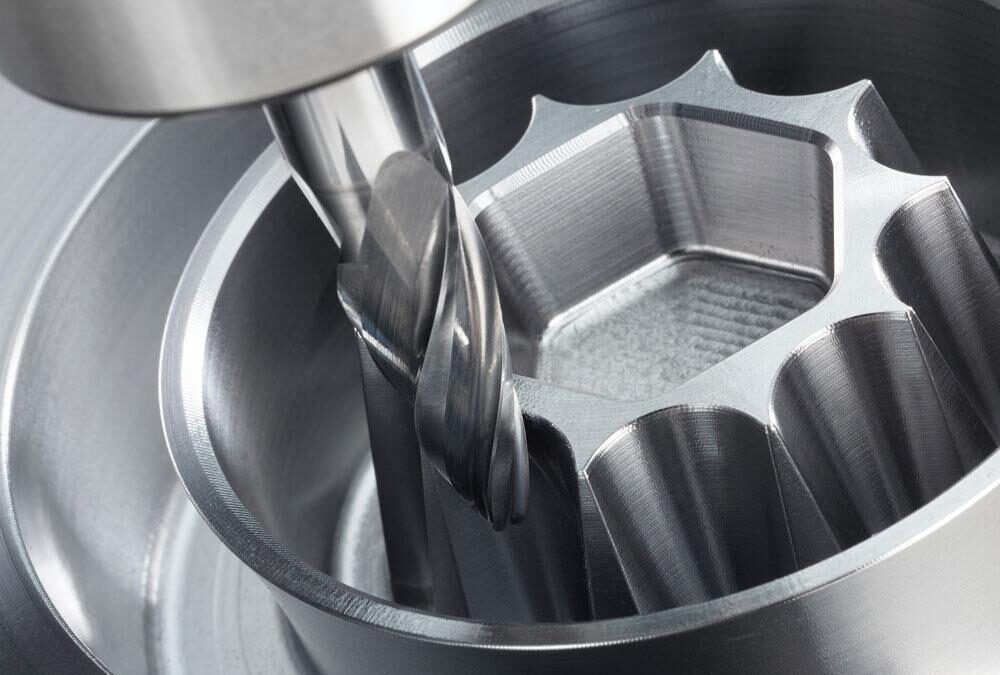
Ultra-stable CNC tool control has become a core requirement in modern turbomachinery manufacturing, where turbine rim recess profiles are increasingly engineered with complex, variable-geometry contours designed to optimize structural load paths, aerodynamic efficiency, and thermal performance. As aerospace propulsion technologies advance, turbine rims incorporate multi-functional recesses that serve as attachment interfaces, cooling flow channels, rotational load distributors, and vibration dampeners. These recesses are no longer simple circular or uniform cavities; they feature multi-axis curvature, multi-radius blending, depth transitions, and asymmetrical pocket geometries that require extreme machining precision. The precision of these rim recess profiles directly influences the rotor’s mechanical stability, fatigue life, and overall engine efficiency, making CNC tool control stability a critical success factor. Ultra-stable tool control ensures that the cutter maintains consistent surface engagement, unbroken profile accuracy, and micron-level dimensional fidelity even when navigating challenging recess geometries with reverse curves or abrupt depth variations. As turbine rims operate under extreme centrifugal forces, high thermal gradients, and high-cycle fatigue conditions, any deviation in the recess profile can introduce dangerous stress risers or performance inefficiencies. For this reason, variable-geometry recess machining cannot rely on traditional cutting strategies; it must incorporate advanced CNC platforms equipped with high-resolution feedback systems, dynamic stabilization algorithms, and multi-axis toolpath coordination to achieve aerospace-grade consistency.
The challenge of machining variable-geometry turbine rim recess profiles lies in maintaining consistent tool control across shifting contour landscapes and structural transitions. Recess profiles often integrate multi-blend radii, segmented curves, steep-walled pockets, and contoured floors that require continuous recalibration of tool orientation, vector alignment, and cutter engagement. Ultra-stable CNC tool control utilizes real-time servo compensation, ball-screw pre-tensioning, thermal drift correction, and high-rigidity machine architecture to maintain micron-level repeatability throughout long machining cycles. Modern CAM platforms automatically generate curvature-driven toolpaths that adjust to geometric complexity, controlling step-over distance, chip load, and tool angle to preserve uniform material removal across recess transitions. Whether the geometry requires swarf cutting, 5-axis contour milling, barrel-tool finishing, or ultra-fine ball-nose detailing, the toolpath must respond smoothly to slope changes and curvature gradients. These systems also leverage advanced kinematics simulation to map tool deflection behavior before machining begins, helping engineers predict where additional reinforcement or speed reductions are required. The result is superior profile continuity, absence of gouging or chatter marks, and reliable retention of engineered geometry. As turbines become more compact and thermally efficient, variable-geometry rim recesses grow more intricate, demanding tool control stability that can only be achieved with advanced multi-axis CNC machining platforms.
Surface integrity is another pivotal outcome of ultra-stable CNC tool control in turbine rim recess production. High-performance materials such as nickel-based superalloys, forged titanium, and high-strength steel are commonly used in turbine rims, each presenting unique machining challenges. These alloys exhibit high hardness, substantial thermal resistance, and low machinability indices, meaning any instability in tool control can lead to surface burns, micro-cracks, chatter-induced vibration marks, or residual stress patterns that compromise component durability. Ultra-stable CNC platforms employ vibration-dampened structures, intelligent spindle-speed modulation, and harmonic suppression algorithms to maintain smooth cutting conditions throughout the machining cycle. This ensures that surface roughness remains well within aerospace specifications, often below Ra 0.6 µm for critical recess features. Through-tool coolant delivery, high-pressure flushing, and temperature-controlled coolant systems further ensure that heat accumulation is minimized, preserving metallurgical integrity. Precision finishing techniques, including multi-step tool refinement and adaptive high-speed finishing passes, help achieve smooth, uniform surfaces even in deep or narrow recess sections. These surface characteristics significantly influence turbine performance, as smoother recess profiles reduce aerodynamic drag, increase fatigue resistance, and enhance component longevity under high-cycle loading. For manufacturers, ultra-stable CNC tool control ensures that each recess meets not only dimensional standards but also the metallurgical and surface-quality requirements that aerospace applications demand.
Beyond geometric accuracy and surface quality, ultra-stable CNC tool control fundamentally transforms production scalability, repeatability, and cost efficiency for turbine rim recess manufacturing. Aerospace production programs require high repeatability across extensive manufacturing batches, with zero tolerance for dimensional drift or variability from one rotor to another. Ultra-stable CNC machine platforms integrate closed-loop feedback systems, automated in-process probing, digital twin validation, and machine learning–driven tool wear prediction algorithms to maintain consistency throughout high-volume production. When a cutter begins to wear or thermal expansion affects axes alignment, the CNC system automatically compensates by adjusting feed rates, offsets, and toolpath vectors. These automated corrections allow for long-cycle, unattended machining operations without sacrificing geometric precision. Additionally, adaptive load monitoring helps prevent tool breakage, extends tool life, and reduces scrap rates. Combined with robotic loading systems, automated part fixturing, and integrated quality inspection, manufacturers can produce turbine rim recess profiles at scale with near-zero deviation. This consistency is essential not only for meeting aerospace certification requirements but also for maintaining aerodynamic and mechanical uniformity across entire fleets of turbine engines. Ultra-stable CNC tool control helps ensure that no matter how complex the recess geometry, each component emerges perfectly aligned with the digital engineering model, maintaining the same tight tolerances across thousands of machined parts.
Looking to the future, ultra-stable CNC tool control will continue to evolve as turbine rim recess designs become even more advanced, incorporating greater geometric variation, thinner wall sections, and deeper internal pocketing. Innovations such as AI-enhanced machining algorithms, real-time adaptive cutting logic, high-magnetic rigidity machine frames, and zero-thermal-distortion spindle systems will further increase machining stability and accuracy. Digital twin integration will become even more advanced, allowing engineers to simulate tool behavior, stress distribution, and thermal flow within the recess before machining begins. New tooling technologies—including nano-diamond coatings, micro-geometry edge enhancements, and high-entropy alloy cutting inserts—will provide better heat resistance, sharper cutting edges, and reduced wear during high-load machining. Hybrid CNC platforms that combine subtractive and additive manufacturing may allow designers to engineer even more radical variable-geometry recesses that push performance boundaries. As aerospace propulsion systems target higher bypass ratios, greater turbine inlet temperatures, and lower fuel consumption, turbine rim recess profiles will continue to play a vital role in structural integrity and aerodynamic performance. Ultra-stable CNC tool control will remain at the heart of this evolution, enabling manufacturers to turn advanced engineering concepts into physically robust, precisely machined turbine components. In this next chapter of turbomachinery advancement, the marriage between high-fidelity CNC technology and variable-geometry design will raise industry standards and expand the future capabilities of aerospace engineering.