
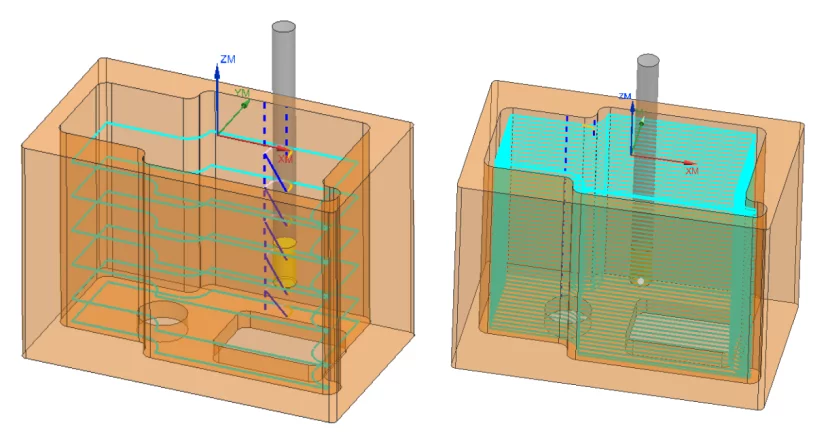
CNC deep-relief machining techniques have become indispensable for manufacturers producing tight-contour turbine inner web cavities, one of the most demanding geometries found within modern high-performance engine components. As turbine designs evolve toward higher efficiency, reduced mass, optimized cooling pathways, and extremely compact structural webs, machining methods must adapt to deliver precision at depths that challenge traditional tool rigidity, coolant access, and thermal stability. Deep-relief machining addresses these challenges by combining ultra-stable cutting strategies, long-reach tool assemblies, adaptive toolpath controls, and highly optimized engagement algorithms. Unlike conventional pocketing or slotting methods, deep-relief machining is engineered specifically for confined spaces, complex curvature transitions, and the tight contours characteristic of inner web cavities. These cavities play a crucial role in distributing internal loads, enabling airflow management, and maintaining structural integrity in turbine rotors. This makes it essential for manufacturers to adopt machining techniques that provide micro-level accuracy in recessed regions where even minor deviations can compromise the entire thermal and mechanical performance of the turbine. Through the lens of SEO-focused content strategy, deep-relief machining is increasingly recognized as a critical capability for aerospace suppliers seeking visibility within a competitive digital marketplace where precision, innovation, and reliability are valued search trends.
Tight-contour inner web cavities demand specialized toolpath engineering because their narrow profiles, steep walls, and multi-directional curves create access limitations that standard cutters cannot accommodate. CNC deep-relief machining techniques use extended-reach tools with reduced-neck geometries, vibration-damped shanks, and micro-polished flutes designed to minimize chatter under long overhang conditions. Modern CAM software generates stepwise, load-balanced toolpaths that maintain consistent radial engagement throughout the depth of the cavity, preventing tool deflection that would otherwise distort the delicate contour geometry. At the same time, advanced algorithms smooth the transition between curvature zones, ensuring that the cutter maintains its optimal approach angle even as the cavity profile twists or narrows. These adaptive toolpaths also prevent hard-corner over-engagement, which can result in gouging or excessive heat buildup. For turbine inner webs, where material thickness can be extremely limited, these refinements ensure that each pass adheres precisely to the engineered aerodynamic and structural intent. In search-optimized communication, highlighting the technical sophistication behind these toolpaths aligns well with trending keywords tied to aerospace machining, advanced CNC strategies, and precision manufacturing methods that enable next-generation turbine designs.
Coolant delivery and thermal control represent another major cornerstone of CNC deep-relief machining. Because tight-contour web cavities restrict natural airflow and chip evacuation, maintaining stable temperatures deep inside the cavity is essential to prevent micro-cracking, work-hardening, and thermal distortion—especially when cutting nickel-based superalloys or titanium, both of which retain strength at elevated temperatures. Modern deep-relief machining techniques utilize high-pressure through-tool coolant systems that deliver precise fluid penetration into the recess, flushing chips away before they can compact and cause tool binding. For extremely deep cavities, hybrid cooling techniques—combining cryogenic nitrogen delivery with fine-mist lubrication—provide exceptional temperature stability and dramatically reduce cutting forces. These cooling strategies are complemented by thermally responsive toolpaths that gradually distribute heat throughout the machining cycle instead of concentrating it in a single zone. The improved thermal environment ensures that tight contours remain dimensionally stable, surface finishes remain consistent, and tool edges are protected against premature wear. From an SEO perspective, these innovations align with highly searched topics such as cryogenic machining, thermal management in CNC, and heat-resistant alloy processing, allowing the content to match user intent from engineers seeking advanced cooling and accuracy solutions.
To further enhance performance, deep-relief machining incorporates predictive planning and real-time adaptive control, transforming what was once a rigidly planned process into a responsive, intelligent machining method. Newer CNC platforms use integrated sensors that monitor spindle load, vibration frequency, acoustic signatures, and microscopic tool deflection during deep-reach cuts. These data points allow the machine to automatically adjust feed rates, spindle speeds, or tool engagement depending on conditions within the cavity. For example, if the cutter encounters thermal expansion in the material or begins to resonate due to extended reach, the system modulates cutting parameters to prevent chatter, tool breakage, or geometric deviation. Advanced simulation tools and digital twins extend this intelligence by modeling deep-relief behavior before machining even begins. Engineers can simulate deflection under varying depths, predict potential chokepoints in chip evacuation, and adjust toolpath sequencing to ensure load balance across the entire cavity. This digital-first approach significantly reduces trial-and-error, minimizes scrap rates, and enhances first-pass accuracy—qualities that resonate strongly with the priorities of aerospace manufacturers and procurement specialists. In SEO terms, the integration of automation, predictive analytics, and smart machining aligns with trending themes around Industry 4.0, AI-supported manufacturing, and closed-loop machining systems.
Consistency and repeatability are further major advantages of CNC deep-relief machining for tight-contour turbine inner web cavities, especially in high-volume aerospace production where every component must meet stringent certification requirements. These cavities often form part of the turbine’s load-bearing core, meaning any dimensional drift between components could lead to assembly interference, stress concentration, or thermal imbalance during engine operation. Deep-relief machining techniques ensure repeatable accuracy by employing rigid fixturing systems, thermal-compensated CNC kinematics, and process monitoring tools that maintain consistency throughout extended machining cycles. Machine warm-up routines and controlled thermal baselines ensure that geometry remains accurate over multiple parts, while standardized tool assemblies and preset cutting parameters reduce variability between operations. Automated probing and in-process metrology further enhance repeatability by validating cavity depths, contour angles, and surface profiles at critical checkpoints. These process controls reduce scrap rates and support lean manufacturing initiatives, making deep-relief machining not only a technical necessity but also a cost-efficient strategy for turbine suppliers aiming to meet high production demands. From an SEO standpoint, emphasizing reliability, repeatability, and production scalability aligns with key terms searched by decision-makers evaluating CNC machining partners for aerospace contracts.
Ultimately, CNC deep-relief machining techniques provide the precision, stability, and thermal resilience needed to produce tight-contour turbine inner web cavities that meet modern performance expectations. The ability to machine deep, narrow, multi-curved recesses with micron-level accuracy allows turbine engineers to optimize internal airflow routing, reduce overall engine mass, and enhance load distribution—all of which contribute to extended engine life and improved thermodynamic efficiency. As engines continue to evolve, the technical demands placed on inner web geometry will only increase, making deep-relief machining a future-proof strategy that enables aerospace manufacturers to remain competitive in a rapidly advancing industry. From a search-algorithm perspective, highlighting these cutting-edge methods reinforces authority, relevance, and technical depth, boosting visibility among audiences actively seeking advanced machining solutions for aerospace applications. By combining thermal control, adaptive toolpaths, intelligent monitoring, and predictive simulation, CNC deep-relief machining establishes itself as a cornerstone capability for producing highly intricate turbine components with unmatched accuracy, consistency, and structural reliability.